Please don’t start reading until you have some idea of what insulin costs these days. It’s scary and sad, and realizing how much of your household income will go to this necessity can send you into shock. Or a panic attack. I’m not kidding. It sucks, but it’s not the end of the world. You have a child (or other loved one) who will not die before the end of the week because pharmaceutical insulin exists.
You can do your own research, but list price for 3 milliliters of a modern insulin in a delivery pen runs about $100. This is U-100 concentration, so that’s 300 units. My son is 155 lbs with no insulin resistance and uses about 60 units per day, so, if we were paying cash, with no insurance write-off and no out-of-pocket limit, that would be $7300 per year. What if I told you that there was an insulin that was just $25 per 1000 units, or just $550 per year? There is such an insulin. And you don’t want it.
Elsewhere on this site you’ll read how modern insulins have been engineered to make the body’s uptake of an injection as close as possible to the body’s uptake of natural pancreati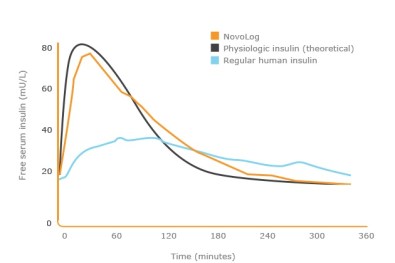 c insulin. This allows one to consume normal amounts of normal food without an inordinate amount of time between dosing and eating. Prior to the development of these insulins, regular human insulin was all we had, with both a longer uptake time and a longer duration of action. The chart here tells the story. The black line is the way normal people access insulin. The blue line is regular human insulin, but injected rather than delivered to the liver by the pancreas. The yellow line is Novo Nordisk’s modern “fast” insulin. A real modern miracle.
So – there are serious trade-offs to using this cheap insulin. Without deliberate management, you’d suffer a blood glucose high as the carbs hit and before the insulin kicks in. Then, a low is more likely as insulin remains in the system long after digestion. Neither of these is healthy. Obviously those with diabetes managed for decades on “old” insulin, though, and some older diabetics prefer this medium-acting, so called “rapid” insulin, claiming headaches and other effects from the “fast” kind.
Before I go further, let me emphasize that there are programs out there to provide modern, superior insulins at affordable prices to those who are truly financially needy. Some companies offer year-long discounting to urge you to switch. Others offer programs that seem to be simply humanitarian in nature. There are also non-profits prepared to connect you to insulin in some economical way. DO NOT ECONOMIZE BY TAKING TOO LITTLE INSULIN!!!
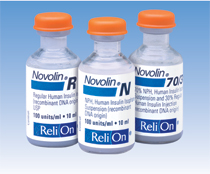
All that said, how do you get this stuff for $25? Believe it or not, in most states it’s over-the-counter…without a prescription…from WalMart. They re-package it under their ReliOn brand. As of this writing the insulin itself  is Novolin, but in the past it’s been Humulin. They basically play Eli Lilly and Novo Nordisk off against one another to keep that $24.88 price. At this price point Wal-Mart offers regular human insulin – Novolin R, they offer delayed reaction insulin, Novolin N, and they offer a 70/30 mix that creates an extended reaction similar to the extra post-meal bump seen in normal blood insulin levels. (Editor’s note, similarly re-branded Novolin formulations are now available for $25 at CVS, and see our posts elsewhere about pricing from GoodRx.)
As I’ve said elsewhere on Type1News, no ethical physician would prescribe regular insulin these days. However, for some patients, the uptake curve of ReliOn N makes for a reasonable basal dose (if directed by a physician!) injected every 12 hours rather than once per day. We personally know diabetics dosing like this. Most intriguing is the notion of using regular insulin (Novolin R)in a pump, for basal dosing, at least. One could imagine a dual-reservoir pump with a supply of cheap insulin for the less-time-critical basal dose and a separate supply of the latest insulin for well-controlled mealtime dosing. Obviously the increased complexity would cancel out much of the savings, but it would be nice to only pay for the fast insulin that you need to be fast!
Here’s the insidious thing: The best we can figure, it costs no more to manufacture these modern insulins than it does to manufacture old-fashioned regular. Both are made in that recombinant DNA process…they just use just different bacteria engineered to produce a slightly different insulin. The extraction, processing, packaging and shipping are all the same! So, although one can think of constructive ways to use cheap insulin, its cheapness is politico-economic, not chemical. It would be “easier” to make effective insulin cheap than to make cheap insulin effective.
Still, isn’t it good to know that if you’re in a strange city and lose your insulin…and they don’t have your pharmacy but it’s a state that allows this over-the-counter sales…you can keep body and soul together for a couple of days. Likewise, it’s good to know if you had an insurance disruption but didn’t yet qualify for assistance, there is an option available. We recommend considering this information carefully so you’re ready to make use of it in the worst of times.
 Type1News