Again, this site does not intend to give medical advice, but insights and anecdotes from our own family’s experiences managing type 1 diabetes.
My son turned 26 and had to go on a new health care plan – the one offered by his employer. Through the convoluted business practices of the insurance companies involved, a different brand of insulin was on the “formulary,” the list of approved medications. These lists are seldom determined by medical efficacy, but instead because of so-called Pharmacy Benefit Managers, the people who “negotiate” with the pharmacy firms. They approach the drug makers with the question, “how low a price would you give us if we guaranteed that all of our policyholders have to buy from you instead of your competition?” It is either the most un-American aspect of the healthcare system, or the most uniquely American aspect of healthcare, depending upon your point of view, I guess.
At any rate, my son had to switch from Eli Lilly’s Humalog to Novo Nordisk’s Novolog. You may recall that the fast insulins basically involve molecules that are already more broken down than human insulin. In these two competing products, the molecules are a bit different, but more importantly, the preservatives and other ingredients are different.
The good news is that the switch between brands did not cause any significant problems. My son’s blood sugar management had been very good with Lilly and has continued to be good with Novo Nordisk. It’s still a sin that insurance companies are allowed to nullify your Doctor’s best judgement and force you to change medications, but in this instance, anyway, things seem to be going okay. The real problem with the new plan is the short supply they allow at one time. That’s another post. Best of luck if you have to switch insulin under similar circumstances. Let us know how it goes!
It may be that CGM’s – Continuous Glucose Monitors – are the area for greatest improvement in diabetes management. CGM’s involve a subcutaneous probe poked about 1/4 inch into the skin, essentially in the same fleshy layer into which insulin is injected. The probe is a soft plastic tube rather than a needle in the skin. Knowing how it resides in a fluid layer under the skin, we refer to this probe as the “wick.” It connects to an electronic device we call the “puck,” via little electric traces – just as a glucose tester connects to glucose strips. The puck has a bluetooth-style connection to an external monitor; either an insulin pump or a separate handheld device. Used with a pump, the system reports out blood glucose about once every 5 minutes, hence the term Continuous.
No matter who your device manufacturer is, they have a high monetary motivation to keep you happy with their system, so they liberally provide replacement CGM probes without additional cost.
This ability to collect ongoing data allows a sufficiently sophisticated pump or other monitor to make predictions about future blood glucose. Having collected user data for years, now, therapy manufacturers have developed sophisticated algorithms to predict low blood sugar and predict response to insulin under different circumstances.
When Medtronic first announced the CGM and pump combo used by my son, theybranded the predictive app algorithms with IBM’s “Watson” AI brand. By the time the system was released, this branding was eliminated. Given our experience, I think IBM decided they didn’t want their brand possibly sullied by ultimately UNpredictable real-world results! Even with regular calibration, a CGM can easily be 20 to 40 points off. Even the best algorithm will fail given faulty inputs. Just ask the crew from 2001: A Space Odyssey!
The main point of this post is to warn you about the luck we have “installing” these CGMs. They get loaded into a spring-cocked “serter,” and poked into the abdomen – or for some folks, the back of the arm. As the wick goes into the skin, it is accompanied by a steel needle providing the structure for the flimsy wick to poke through. Once the needle is withdrawn there is sometimes bleeding. Although one can stop this bleeding by pressing on the external plastic frame for a period of minutes, the bleeding itself may compromise the install. The wick is not really designed to reside in free, possibly coagulating blood, and so it’s hard to bring the CGM to proper calibration. All this is to say that we have to discard nearly half of these CGM probes, despite our research into bleeding avoidance! No matter who your device manufacturer is, they have a high monetary motivation to keep you happy with their system, so they liberally provide replacement CGM probes without additional cost. Still, having to address a bleeding wound can be dispiriting, to say the least.
Another company, Dexcom, is currently marketing their CGM touting how long it can go without calibration – how many “finger sticks” it can eliminate. We have no experience with Dexcom, and it may indeed need little calibration, but in any tradeoff between accuracy and fewer finger sticks, WE choose accuracy. A sharp lancet, calibrated to the right depth, really doesn’t do lingering damage – so long as the fingertips are adequately cleaned with an alcohol swab! Given the long-term and short-term risks of insulin therapy based on inaccurate numbers, drawing a little blood is, so far, a worthy tradeoff.
Now, if the Dexcom has a higher insertion success rate, that’s another story. As Medtronic customers, we understand that the Dexcom probe goes in diagonally, so that part of the experience may be superior! We’re truly grateful to Medtronic for helping to keep our person with diabetes alive, so we nag them about few things. However, we believe the “closed systems” operated by device manufacturers…the non-interoperability…is a critical weakness, if not a moral offense. Let’s be magnanimous about the way we put this, rather than run anyone down: if Dexcom has a superior CGM but Medtronic has a superior pump, not being able to put these superior solutions together risks lives. We believe that the profit motive – wanting to guarantee sales of a whole system – gives all of these manufacturers a vested interest that may compromise their decision making!
So, algorithms aside, there’s room for improvement just getting data to the system. CGMs are literally lifesavers, alerting one to low or even pending low blood sugar. We would love to share the experiences of Dexcom customers, too, so – get in touch if you have a story to tell!
A couple of weeks back Congress approved a temporary extension of funding for the Special Diabetes Program, which funds studies at the National Institutes for Health. It funds programs known as TrialNet and TEDDY, along with other research related to diabetes. We call and tweet our Washington contingent regularly as diabetes funding reaches the floor, and hope you do the same.
To the extent that there is a community of those with Type 1, there is a grim joke among them about how a cure is always only 5 years away. A press release goes out…there may be a couple of anecdotes that make the news, but there is seldom significant progress toward “curing” Type 1. This is a shame, because – as an autoimmune disease – progress in understanding and treating Type 1 should advance cures for millions and millions with various diseases.
We’re actually pretty satisfied with the advocacy efforts directed toward research. It seems it’s easier to get Washington to spend money than it is to get Washington to help you save money.
Don’t expect the American Diabetes Association or JDRF to put their full effort into these pricing issues, as they EACH get more than one million dollars per year from Lilly. ADA proudly recognizes both Novo Nordisk and Sanofi as big contributors, as well.
We want to feel good about the companies that create the compounds and devices that keep our kids alive, but it’s hard to accept that there are good people involved when the price of good insulin has have gone up – UP – by a factor of 13 times, from $21 in 1996 to $275-ish dollars in 2020 – even as patents have expired and competitors have entered the marketplace! As they say about much of capitalism, the system’s not broken, it was built this way.
Sure, pharmaceutical companies have “discount cards” and various “if you can’t afford your prescriptions, Merck is here to help” sort of programs. Eli Lilly’s average income on a unit of insulin likely ISN’T 13 times what it was in 1996. Our guess is that these discount programs are all written off as charitable or advertising expenses, lowering their tax bill. According to Public Integrity, on $600 million in US income in 2018, Eli Lilly paid zero taxes. Zero. In exchange for Lilly being able to write off $240 per vial in offering a $35 price voucher, some individuals find themselves paying $275 in some circumstances. This complexity is killing people an driving American families to medical bankruptcy!
Don’t expect the American Diabetes Association or JDRF to put their full effort into these pricing issues, as they EACH get more than one million dollars per year from Lilly. ADA proudly recognizes both Novo Nordisk and Sanofi as big contributors, as well. Frankly, the AARP is the best advocate for insulin prices we’ve seen, and – surprise – we couldn’t immediately find any evidence that insulin companies are among their donors.
This post is starting to ramble. I mean to say, that insulin prices are so obscene, that it should be an “easy win” for the non-profit diabetes community to advocate for better retail prices. Not just Medicare prices accessible to some, not out-of-pocket prices for those with good insurance – the base retail price accessible to all. Again, the system isn’t broken, it was built this way. Still, you may encounter a sympathetic legislator and change the world if you reach out faithfully. Good luck to all of us.
Elsewhere at Type1News you’ll find information about how blood glucose control can change over the course of a single day. One of the final pieces of the puzzle has to do with changes over a much longer timespan – over the course of a year.
In Spring a young man’s fancy lightly turns… Tennyson observed, and most of us observe a change in our metabolism as the days grow longer. Given that insulin requirements are closely tied to metabolism, there is bound to be a need for adjustment as the seasons change. They just may not be as you expect. Please read this particular article with caution, as your results, as they say, may vary.
The person in our household with Type 1 diabetes is still in his 20’s, and so these seasonal effects are still fairly pronounced. I think most of us are aware that heavy exercise can make one’s cells capable of burning some carbs in an absence of insulin. Because of this, one might think that less insulin is needed in the spring. We’ve actually found the opposite.
It seems that digestion is affected by these metabolic changes more than the body’s ability to burn carbs. So, in the spring, we’ve found that more insulin is necessary – and faster – after meals. In our case, this adjustment is made by altering the calculated carb-to-insulin ratio. Each season, spring and fall, we spend a few days nudging this ratio until we’re again getting good blood sugar control. The change comes on pretty quickly in the spring, over maybe 10 days and then there’s no further progression. In the fall it seems to take just a little longer, but it is remarkable how quickly the metabolism slows back down for winter.
Any change in the insulin ratio can be more complex to implement than you think. A change in ratio from daypart-to-daypart is a prescribed by our endocrinologist as a preferred method of pump managment. Some of these changes are probably legitimate differences in daily metabolism, but some of these adjustments seem to be to “trick” the pump or alter the curves for best result. Overlay an overall ratio change to this system, and the results can be unpredictable. Approach these seasons with caution!
In addition to the normal circadian effects, be on the lookout for seasonal allergies. Inflammation caused by allergies raises blood glucose, sometimes fairly dramatically, resulting in some of those surprise mornings near 300 that we hate to see! Antihistamines may not only address allergies you experience, but they may also suppress a general background inflammation you were unaware of, resulting in dangerous lows. We try to make extra time for mid-night glucose checks and calibration in these tricky times of year.
If you go into your first year of diabetes management expecting these effects, you’ll stay safer and learn more that first year, so the subsequent years can be more familiar. As always, good luck. Our thoughts are with you.
This is a hard post to write, because it’s about the scariest aspect of diabetes care: hypoglycemia. HyPER glycemia is high blood sugar concentration, and a long-term risk for all people with diabetes. This post is about hyPO glycemia, very low blood sugar, and it’s a deadly situation.
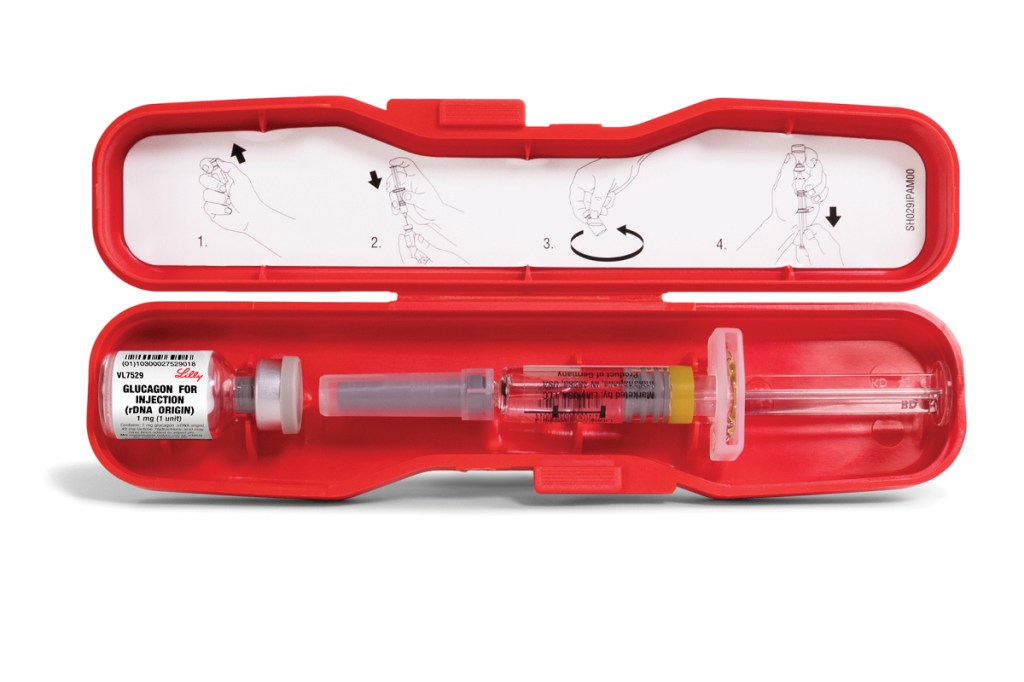
Eli Lily’s packaged glucagon
First of all, if your endocrinologist has somehow neglected to prescribe a glucagon syringe (pictured) get a prescription today (and maybe a new endo!).
Very low blood sugar deprives the nervous system of the chemicals it needs to function properly. The person suffering the “low” can lose consciousness and have seizures. If the low persists or worsens it can lead to death. Your perception of diabetes will change forever once your family experiences a hypo. Few things in life earn the term “terrifying.” A hypo with seizure is truly terrifying. It can be emotionally debilitating, because you now know that risk is always there, lying in wait. This is the part where I’m supposed to have something encouraging to say, but I got nuthin’. This sucks big time.
The main reason I write this post in a “beginning” diabetes blog, is because early after diagnosis, the person with diabetes will likely “feel” lows coming on, and may even be awakened. Sadly, crushingly, years of having blood sugar swings may make one less sensitive, and at risk of trending low overnight without recognizing it. For this reason, we consider Continuous Glucose Monitoring (CGM)to be a key component of the only humane health care course for those with diabetes. A CGM device with alarm, and preferably with “shutoff” control of insulin.
The glucagon pen above is the emergency treatment for someone who is low, likely recognized by entering siezure. I hate to break it to you, but a person with diabetes should never sleep alone. Good luck using that one at a singles bar! A sleepmate should always be in a position to recognize the twitching or thrashing of a seizure and trained to administer glucagon. The instructions are simple-enough, but you don’t want to be learning in the heat of an event! The glucagon triggers the liver to dump glucose into the blood stream, hopefully restoring consciousness.
To prevent low blood sugar events from reaching dangerous conditions, a CGM plus insulin pump work together to shut off insulin at selectable blood sugar concentrations. Modern pumps from Medtronic and Tandem can even use trending data to “Suspend Before Low” as the function is called. Living in great fear of hypos, we have selected the settings offering the highest-possible protection. Now, going without basal insulin for a while can result in a later “high,” but we’ve had good results in our household for the most part, with early morning blood sugars below 130 for the most part.
We’ll try to take up this dynamic interaction between automatic pumps and human metabolism at a later date. For the time being, get that glucagon and know where it is…and make sure you can hear, if not feel, your loved one who sleeps…and lives…with diabetes. Good luck! May these circumstances ever be strange to you and never experienced!
Hints and Help from a Family Processing News about Type 1 Diabetes


 Type1News