When my son first got his insulin pump, we figured it would just do his normal dosing…on a clock or on demand. The only real benefit would be that he’d already be hooked up to the needle. We understood there was the trickle of a basal dose, and then the kick of a bolus at meals. I am pleased to say that pump developers are simply more ingenious than that. They take the basic ideas of delivery rate and delivery time to better synthesize the way the body produces insulin.
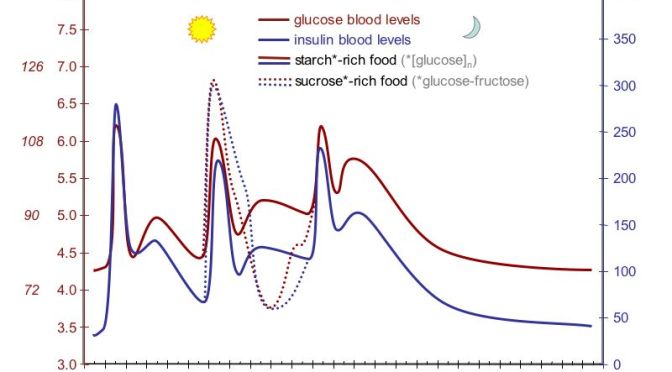
The graph above shows, among other things, how much insulin is in the
body over the course of a typical day. You can see how the “lulls” are still supported by that basal amount of insulin, and see the mealtime delivery of insulin in response to starch and sugar. You can pretty readily see that the insulin curve is more complicated than a single, steady-state dose with 3 peaks. That background insulin is far higher between meals than it is overnight. Thankfully, modern insulin pumps allow multiple basal rates depending upon the time of day! There’s a post-meal adjustment as sugars enter the bloodstream. Fast insulins might not have the sort of prolonged post-meal effect you see here (see our article on the Pizza Effect) but that follow-on dose can be synthesized wi th what they call a dual-wave or Combination bolus, wherein one programs some percentage of your mealtime insulin to be delivered as an all-at-once bolus, but then an increased background dose to deliver the rest over a prolonged period. For extremely fatty foods or for even healthy foods with a high glycemic index (carbs digested slowly), one might program a so-called square wave delivery of insulin, simply taking that steady background dose to an elevated level for a time – with no real bolus at all!

 Type1News