Category Archives: Insulin

Making the Switch – Some Good News

Just a quick post.

Again, this site does not intend to give medical advice, but insights and anecdotes from our own family’s experiences managing type 1 diabetes.

My son turned 26 and had to go on a new health care plan – the one offered by his employer. Through the convoluted business practices of the insurance companies involved, a different brand of insulin was on the “formulary,” the list of approved medications. These lists are seldom determined by medical efficacy, but instead because of so-called Pharmacy Benefit Managers, the people who “negotiate” with the pharmacy firms. They approach the drug makers with the question, “how low a price would you give us if we guaranteed that all of our policyholders have to buy from you instead of your competition?” It is either the most un-American aspect of the healthcare system, or the most uniquely American aspect of healthcare, depending upon your point of view, I guess.

At any rate, my son had to switch from Eli Lilly’s Humalog to Novo Nordisk’s Novolog. You may recall that the fast insulins basically involve molecules that are already more broken down than human insulin. In these two competing products, the molecules are a bit different, but more importantly, the preservatives and other ingredients are different.

The good news is that the switch between brands did not cause any significant problems. My son’s blood sugar management had been very good with Lilly and has continued to be good with Novo Nordisk. It’s still a sin that insurance companies are allowed to nullify your Doctor’s best judgement and force you to change medications, but in this instance, anyway, things seem to be going okay. The real problem with the new plan is the short supply they allow at one time. That’s another post. Best of luck if you have to switch insulin under similar circumstances. Let us know how it goes!


Make Yourself Heard

A couple of weeks back Congress approved a temporary extension of funding for the Special Diabetes Program, which funds studies at the National Institutes for Health. It funds programs known as TrialNet and TEDDY, along with other research related to diabetes. We call and tweet our Washington contingent regularly as diabetes funding reaches the floor, and hope you do the same.

To the extent that there is a community of those with Type 1, there is a grim joke among them about how a cure is always only 5 years away. A press release goes out…there may be a couple of anecdotes that make the news, but there is seldom significant progress toward “curing” Type 1. This is a shame, because – as an autoimmune disease – progress in understanding and treating Type 1 should advance cures for millions and millions with various diseases.

We’re actually pretty satisfied with the advocacy efforts directed toward research. It seems it’s easier to get Washington to spend money than it is to get Washington to help you save money.

Don’t expect the American Diabetes Association or JDRF to put their full effort into these pricing issues, as they EACH get more than one million dollars per year from Lilly. ADA proudly recognizes both Novo Nordisk and Sanofi as big contributors, as well.

We want to feel good about the companies that create the compounds and devices that keep our kids alive, but it’s hard to accept that there are good people involved when the price of good insulin has have gone up – UP – by a factor of 13 times, from $21 in 1996 to $275-ish dollars in 2020 – even as patents have expired and competitors have entered the marketplace! As they say about much of capitalism, the system’s not broken, it was built this way.

Sure, pharmaceutical companies have “discount cards” and various “if you can’t afford your prescriptions, Merck is here to help” sort of programs. Eli Lilly’s average income on a unit of insulin likely ISN’T 13 times what it was in 1996. Our guess is that these discount programs are all written off as charitable or advertising expenses, lowering their tax bill. According to Public Integrity, on $600 million in US income in 2018, Eli Lilly paid zero taxes. Zero. In exchange for Lilly being able to write off $240 per vial in offering a $35 price voucher, some individuals find themselves paying $275 in some circumstances. This complexity is killing people an driving American families to medical bankruptcy!

Don’t expect the American Diabetes Association or JDRF to put their full effort into these pricing issues, as they EACH get more than one million dollars per year from Lilly. ADA proudly recognizes both Novo Nordisk and Sanofi as big contributors, as well. Frankly, the AARP is the best advocate for insulin prices we’ve seen, and – surprise – we couldn’t immediately find any evidence that insulin companies are among their donors.

This post is starting to ramble. I mean to say, that insulin prices are so obscene, that it should be an “easy win” for the non-profit diabetes community to advocate for better retail prices. Not just Medicare prices accessible to some, not out-of-pocket prices for those with good insurance – the base retail price accessible to all. Again, the system isn’t broken, it was built this way. Still, you may encounter a sympathetic legislator and change the world if you reach out faithfully. Good luck to all of us.

Seasons’ Change

Elsewhere at Type1News you’ll find information about how blood glucose control can change over the course of a single day. One of the final pieces of the puzzle has to do with changes over a much longer timespan – over the course of a year.

In Spring a young man’s fancy lightly turns… Tennyson observed, and most of us observe a change in our metabolism as the days grow longer. Given that insulin requirements are closely tied to metabolism, there is bound to be a need for adjustment as the seasons change. They just may not be as you expect. Please read this particular article with caution, as your results, as they say, may vary.

The person in our household with Type 1 diabetes is still in his 20’s, and so these seasonal effects are still fairly pronounced. I think most of us are aware that heavy exercise can make one’s cells capable of burning some carbs in an absence of insulin. Because of this, one might think that less insulin is needed in the spring. We’ve actually found the opposite.

It seems that digestion is affected by these metabolic changes more than the body’s ability to burn carbs. So, in the spring, we’ve found that more insulin is necessary – and faster – after meals. In our case, this adjustment is made by altering the calculated carb-to-insulin ratio. Each season, spring and fall, we spend a few days nudging this ratio until we’re again getting good blood sugar control. The change comes on pretty quickly in the spring, over maybe 10 days and then there’s no further progression. In the fall it seems to take just a little longer, but it is remarkable how quickly the metabolism slows back down for winter.

Any change in the insulin ratio can be more complex to implement than you think. A change in ratio from daypart-to-daypart is a prescribed by our endocrinologist as a preferred method of pump managment. Some of these changes are probably legitimate differences in daily metabolism, but some of these adjustments seem to be to “trick” the pump or alter the curves for best result. Overlay an overall ratio change to this system, and the results can be unpredictable. Approach these seasons with caution!

In addition to the normal circadian effects, be on the lookout for seasonal allergies. Inflammation caused by allergies raises blood glucose, sometimes fairly dramatically, resulting in some of those surprise mornings near 300 that we hate to see! Antihistamines may not only address allergies you experience, but they may also suppress a general background inflammation you were unaware of, resulting in dangerous lows. We try to make extra time for mid-night glucose checks and calibration in these tricky times of year.

If you go into your first year of diabetes management expecting these effects, you’ll stay safer and learn more that first year, so the subsequent years can be more familiar. As always, good luck. Our thoughts are with you.

The Protein Effect

If you or your loved one with diabetes is lucky enough to have an insulin pump, congratulations, again. Too few insurance providers recognize the superior results of insulin therapy using just the “fast” insulin. There are cases, though, where digestion takes a while, and the mealtime bolus is used up or is otherwise inadequate to aid digestion of non-carb foods. This applies in particular to a high protein meal, described elsewhere as “above 80 grams” of protein.

You’ll find your own rules and your own ratios, but it’s suggested that those who are on pumps with fast insulin plan on a second bolus 90 minutes to two hours after eating a big meal. This isn’t to account for the actual sugars you’ve eaten (carbs) but to account for sugars generated in the digestion of protein. The suggested ratio is one third to one half of your carb ratio for every gram of protein. My son has great results with a one third ratio, and he triggers the protein bolus one hour after starting the meal. This has been the last piece of the puzzle to get really good blood glucose numbers. His A1C was an enviable 5.5 his first test after learning of the effect! His subsequent A1C’s have been lower, still, but this is not a contest. Best of luck to you.

Some quick math – in trying to keep your carb intake low, your strategy may involve double burgers or some other way to get more protein without adding carbs. A fairly lean 4 ounce burger will have 18 grams of protein. A bun will have about 4 grams of protein, and a generous slice of cheese another 4. If you’re having  the equivalent of a double burger, a single and two buns, that’s around 60 grams of just protein, certainly approaching a big meal for anyone. Your meal bolus would be for the 40 or 50 grams of carbs in the buns and condiments. The Mass Effect – the sheer mass of protein to be digested and generating sugars – well, that would require additional insulin equal to 20 or 30 grams of your carb ratio,  taken about 90 minutes later.

This greater awareness of protein has led to the realization that lean poultry is an amazing source of protein. So great that the odds of having digestion issues are much more likely! Just be aware before you slam back that turkey breast sandwich!

As with any medical therapy, ask your doctor, but once you have the go-ahead and you’re experimenting with times and ratios, drop us a line! Pumps themselves, and the fastest new insulins, are both new-enough that this Mass Effect strategy is not well documented. We’d love to get a statistically-meaningful data set from readers and help formalize some best practices for folks with type 1. Again, good luck!

Testing, one-two. Six?

Whether you’re new to diabetes or not, you’re likely aware that the prices charged to insurance plans can vary widely. Only one of two pharmaceuticals regarded as identical may show up on your list of allowed drugs – or not – based upon negotiations that are entirely secret. In the best cases, this allows your insurance plan to put two drug firms into competition. Often in America, this means that the non-negotiated price – the retail price – is fabulously inflated. (See news stories on Epi-pens or Martin Shkreli.) We’re told that this higher starting point allows drug manufacturers to maintain enough margin to innovate on our behalf. A primary side effect is that those without insurance can find that many therapies are simply out of reach. Before the Affordable Care Act, stories of bankruptcies and deaths were prevalent. Knowing human nature, we suspect that many of these stories are absolutely true.

17_cnext_strip-carton_left-athero_100_picture_lowres_png

Even at their negotiated prices, insurance plans are often billed higher rates than you can find for diabetic supplies. This is one reason that plans seem to be so stingy. Your endocrinologist may earnestly submit a prescription for a reasonable 6 tests per day, and your plan budgets you for 4. It’s easy to think there is scholarship or experience behind the allowance, but don’t allow yourself to think this. It’s almost certainly just economics. Information is a key tool in type 1 diabetes, and you shouldn’t skimp.

…test strips…for less than 25 cents…

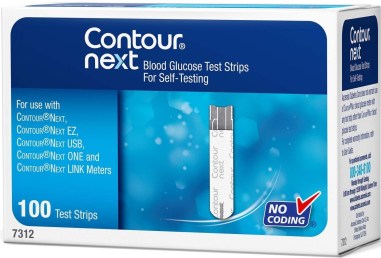
My son’s condition was discovered when he had an incidence of ketoacidosis. While he was still in intensive care he was prescribed Contour Next test strips. When he was released that’s what the Doctor prescribed, and now that he’s moved to an insulin pump, that’s what his integrated glucose tester uses. These strips can easily cost a dollar per test at your pharmacy. Once your deductible is met, I can’t say what your insurance plan pays, but if they’re saving $2 per day by limiting you to 4, that’s $720 per year. A shortsighted savings on their part, but a real savings. We have been augmenting our insurance-provided strips by buying test strips through Amazon.com for around 33 cents each. An extra 100 strips can give you peace of mind by allowing you to test more often each day for almost two months. That’s about $5 per week to allow you to check blood sugar when you’re curious, not just to inform a meal bolus.

We’ve never had any trouble with supplies ending up being post-dated or problems with strips that had been environmentally damaged in shipment. If your experience is otherwise, let us know! We’ll do some research on the vendor and help keep the good guys in business!