Category Archives: Pumps

Love ’em & Hate ’em – Continuous Glucose Monitors

It may be that CGM’s – Continuous Glucose Monitors – are the area for greatest improvement in diabetes management. CGM’s involve a subcutaneous probe poked about 1/4 inch into the skin, essentially in the same fleshy layer into which insulin is injected. The probe is a soft plastic tube rather than a needle in the skin. Knowing how it resides in a fluid layer under the skin, we refer to this probe as the “wick.” It connects to an electronic device we call the “puck,” via little electric traces – just as a glucose tester connects to glucose strips. The puck has a bluetooth-style connection to an external monitor; either an insulin pump or a separate handheld device. Used with a pump, the system reports out blood glucose about once every 5 minutes, hence the term Continuous.

No matter who your device manufacturer is, they have a high monetary motivation to keep you happy with their system, so they liberally provide replacement CGM probes without additional cost.

This ability to collect ongoing data allows a sufficiently sophisticated pump or other monitor to make predictions about future blood glucose. Having collected user data for years, now, therapy manufacturers have developed sophisticated algorithms to predict low blood sugar and predict response to insulin under different circumstances.

When Medtronic first announced the CGM and pump combo used by my son, they branded the predictive app algorithms with IBM’s “Watson” AI brand. By the time the system was released, this branding was eliminated. Given our experience, I think IBM decided they didn’t want their brand possibly sullied by ultimately UNpredictable real-world results! Even with regular calibration, a CGM can easily be 20 to 40 points off. Even the best algorithm will fail given faulty inputs. Just ask the crew from 2001: A Space Odyssey!

The main point of this post is to warn you about the luck we have “installing” these CGMs. They get loaded into a spring-cocked “serter,” and poked into the abdomen – or for some folks, the back of the arm. As the wick goes into the skin, it is accompanied by a steel needle providing the structure for the flimsy wick to poke through. Once the needle is withdrawn there is sometimes bleeding. Although one can stop this bleeding by pressing on the external plastic frame for a period of minutes, the bleeding itself may compromise the install. The wick is not really designed to reside in free, possibly coagulating blood, and so it’s hard to bring the CGM to proper calibration. All this is to say that we have to discard nearly half of these CGM probes, despite our research into bleeding avoidance! No matter who your device manufacturer is, they have a high monetary motivation to keep you happy with their system, so they liberally provide replacement CGM probes without additional cost. Still, having to address a bleeding wound can be dispiriting, to say the least.

Another company, Dexcom, is currently marketing their CGM touting how long it can go without calibration – how many “finger sticks” it can eliminate. We have no experience with Dexcom, and it may indeed need little calibration, but in any tradeoff between accuracy and fewer finger sticks, WE choose accuracy. A sharp lancet, calibrated to the right depth, really doesn’t do lingering damage – so long as the fingertips are adequately cleaned with an alcohol swab! Given the long-term and short-term risks of insulin therapy based on inaccurate numbers, drawing a little blood is, so far, a worthy tradeoff.

Now, if the Dexcom has a higher insertion success rate, that’s another story. As Medtronic customers, we understand that the Dexcom probe goes in diagonally, so that part of the experience may be superior! We’re truly grateful to Medtronic for helping to keep our person with diabetes alive, so we nag them about few things. However, we believe the “closed systems” operated by device manufacturers…the non-interoperability…is a critical weakness, if not a moral offense. Let’s be magnanimous about the way we put this, rather than run anyone down: if Dexcom has a superior CGM but Medtronic has a superior pump, not being able to put these superior solutions together risks lives. We believe that the profit motive – wanting to guarantee sales of a whole system – gives all of these manufacturers a vested interest that may compromise their decision making!

So, algorithms aside, there’s room for improvement just getting data to the system. CGMs are literally lifesavers, alerting one to low or even pending low blood sugar. We would love to share the experiences of Dexcom customers, too, so – get in touch if you have a story to tell!

The Protein Effect

If you or your loved one with diabetes is lucky enough to have an insulin pump, congratulations, again. Too few insurance providers recognize the superior results of insulin therapy using just the “fast” insulin. There are cases, though, where digestion takes a while, and the mealtime bolus is used up or is otherwise inadequate to aid digestion of non-carb foods. This applies in particular to a high protein meal, described elsewhere as “above 80 grams” of protein.

You’ll find your own rules and your own ratios, but it’s suggested that those who are on pumps with fast insulin plan on a second bolus 90 minutes to two hours after eating a big meal. This isn’t to account for the actual sugars you’ve eaten (carbs) but to account for sugars generated in the digestion of protein. The suggested ratio is one third to one half of your carb ratio for every gram of protein. My son has great results with a one third ratio, and he triggers the protein bolus one hour after starting the meal. This has been the last piece of the puzzle to get really good blood glucose numbers. His A1C was an enviable 5.5 his first test after learning of the effect! His subsequent A1C’s have been lower, still, but this is not a contest. Best of luck to you.

Some quick math – in trying to keep your carb intake low, your strategy may involve double burgers or some other way to get more protein without adding carbs. A fairly lean 4 ounce burger will have 18 grams of protein. A bun will have about 4 grams of protein, and a generous slice of cheese another 4. If you’re having  the equivalent of a double burger, a single and two buns, that’s around 60 grams of just protein, certainly approaching a big meal for anyone. Your meal bolus would be for the 40 or 50 grams of carbs in the buns and condiments. The Mass Effect – the sheer mass of protein to be digested and generating sugars – well, that would require additional insulin equal to 20 or 30 grams of your carb ratio,  taken about 90 minutes later.

This greater awareness of protein has led to the realization that lean poultry is an amazing source of protein. So great that the odds of having digestion issues are much more likely! Just be aware before you slam back that turkey breast sandwich!

As with any medical therapy, ask your doctor, but once you have the go-ahead and you’re experimenting with times and ratios, drop us a line! Pumps themselves, and the fastest new insulins, are both new-enough that this Mass Effect strategy is not well documented. We’d love to get a statistically-meaningful data set from readers and help formalize some best practices for folks with type 1. Again, good luck!

Breakthroughs

Just a short note as to why we don’t share a lot of the news about cutting-edge research and breakthroughs you might find in your news feed. We’ve been amazed at how many headlines that cross our screens end up being click-bait – stories (which may be true!) from years ago, re-packaged as if they were new. There’s a story that makes the rounds from 2015 about a gal who had an islet cell transplant (from cadaver pancreases, if you read the detail) and was “cured” of type 1 diabetes! Turns out the story was written just weeks after this transplant, and with no follow-up articles in years, we figure this “cure” didn’t last. Maybe we’ll try to do some research and address the specifics in another article.

It can ruin your day to read a great headline suggesting that your long struggle may soon be over, only to find that you’re mostly a victim of the economics of clicks.

Other stories, too, are about legitimate research, but it’s still in trials or even still deep in the development stage. As much as we want to celebrate this work, our focus will remain on approved therapies or those with a legitimate timetable to come to market.

Pumping Regular

Elsewhere on this site you’ll find information about insulins that are specially-designed for speed. Insulin isn’t normally injected into the bloodstream, but into the layer of fat under the skin. This doesn’t flood your blood with insulin too quickly, but it also doesn’t exactly mimic the rate of insulin generation and absorption from a fully-working pancreas.

These new insulins trigger glucose uptake fast-enough to offset the delay in delivery caused by the way they’re injected. Because of their speed of action and (relatively) short duration of action they are superior for use in insulin pumps.  Pumps, though, pre-date these “modern” insulin formulations, and pump users had superior results as compared to people injecting several times per day. We’ve studied some of the issues involved with this combination and have some advice for those who may be forced for a time to use older insulins, e.g. Humulin R or Novolin R in place of Humalog or Novolog.

Here at Type1News we’ve been fascinated by the reports of these early pump users’ impressive A1C readings. After much study and consideration we think we’ve arrived at an insight into why this worked so well. For safety we’re going tonovologvsmetabolic1 make you read through some basics before sharing.
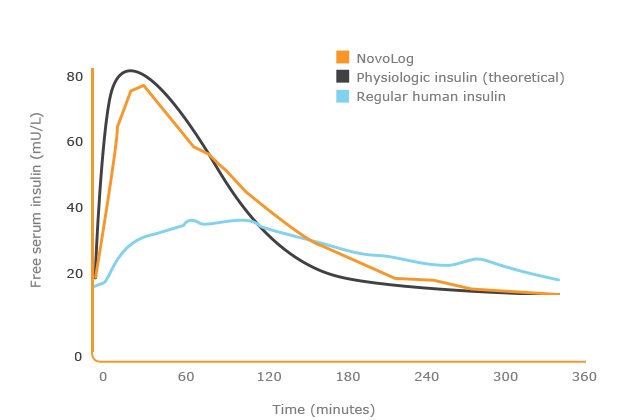
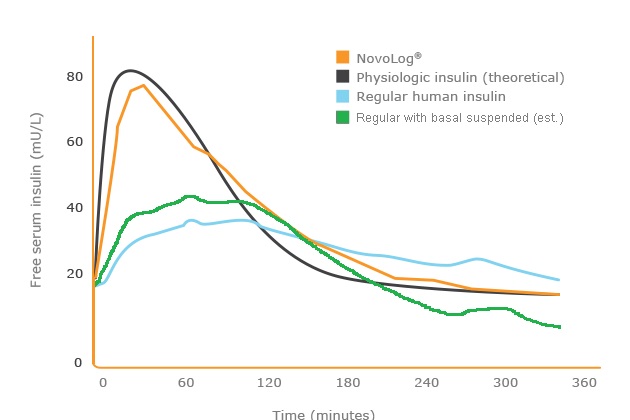
Before we start, it’s worth reviewing the action curves for Novolog (orange in the graph), for normal human pancreatic delivery to the liver (black), and regular human insulin by subcutaneous injection (light blue). Clearly “Regular” is an inferior insulin. We found it interesting, though, that this data is typically presented omitting the bottom 20 mU/L of free serum insulin. Such scale truncation is always suspicious in product literature – as it makes the difference in effect look greater than it actually is. Type1News.com may be the only place on the internet where you’ll find this graph presented with a linear scale. You can see that modern insulins are still far superior, but the difference is not as disastrous as other presentations may (mis)represent.

Before continuing, we want to emphasize again that the difference in price in the United States between Regular insulin and engineered Fast insulin is a result of politics and intellectual property law, not a result of different production and processing. Both Regular and Fast are produced in a miraculous recombinant DNA process. The yeast or other microbes involved have been engineered to produce a different molecule. Outside of the United States, these prices are far lower as are differences in price between formulations, eliminating any motivation to choose an inferior product.

For the purpose of discussion assume that Regular insulin is the only option. Let’s look at the implications.

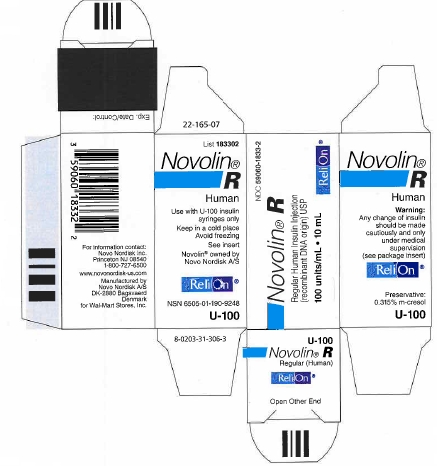
relionregularboxNormally pump users have a basal “trickle” going all day and night and then manually trigger an all-at-once bolus dose at mealtime. Modern pumps deliver this basal not as a steady trickle, but at varying, customizable rates through the day, but always in the background at some rate. Consider the impact if a slower insulin is used for this basal dose. Regular insulins have an onset of action on the order of 30-45 minutes compared to 15 minutes for engineered Fast insulins. This is not a significant consideration for the basal, background, dose. The longer duration of action is also less significant for basal than for bolus delivery.
If you ever consider using Regular in a modern pump, first ensure that you can “tell” the pump that the duration of action is much longer than with Fast insulin. Pumps do much of their magic by accounting for insulin that is still in the bloodstream but hasn’t yet been taken up. Users who in the past reported such good results with regular almost certainly had “tweaked” this duration setting with experience as to their own metabolism. Making adjustments on an emergency basis without this personal history is almost certain to have inferior results – another reason we emphasize that one should use Regular insulin only under the most dire circumstances. We just suspect that a properly adjusted pump can deliver superior results to periodic injection regardless of the insulin involved.

There is some suggestion that Humalog and Novolog are “buffered” differently or otherwise packaged in a way that is conducive to use in a pump. Some say Novolin R “precipitates” solids or otherwise clogs infusion sets. From our discussions with persons who’ve had diabetes for decades, we suspect that these issues with solids actually relate to Novolin N, a delayed uptake insulin delivery compound you can read about elsewhere. Still, another caution that using Regular has risks.

So Regular insulin isn’t a disaster for basal delivery in pumps. In fact, if you used a pump for just basal, Regular would probably be more than fine.

So here’s our insight into bolus dosing of regular insulin in a pump:

Consider the insulin uptake chart yet again. It suggests a basal presence of insulin of something like 15 mU/l. We can’t do a lot to speed the onset of Regular (delay eating as a compromise) but we can address the “hangover” RegMinusBasalextended action by stopping basal delivery for a period after each meal, and adding that basal dose to the bolus. Think of it as “pulling the basal out from under” the lingering bolus dose. The undesirable extended action of the Regular actually serves as the basal between and after meals. Six or even eight hours after the last meal, basal delivery would resume, as the last of the day’s bolus doses are metabolized.

Adding the basal to the bolus raises the serum concentration of insulin at onset of the bolus, which somewhat offsets the slower insulin speed of onset. (The insulin in there is still working slower, but there’s more in there to work!) The green curve in the graph above attempts to show both the higher initial dose and the loss of the steady basal beneath. Again, we’re pulling the basal out from under the bolus curve. Let us know if you don’t understand the concept. It may be worth noting that – were the basal suspended for the other insulins as well, serum insulin levels would drop quicker in any case, but in practice a basal dose is usually left in place. This is either a basal schedule on a pump left in place for convenience’s sake, or a long-acting basal injected hours earlier.

Again, none of this consideration would be necessary if it weren’t for the dramatic price difference between $265 per vial Novolog R and $25 per vial Relion Novolin R. This difference is essentially a political choice rather than a truth of chemistry. Still, if any of these insights help someone get by with Regular when there’s no option, we wish you the best possible results and believe there is reason for optimism. Please consult a medical professional and especially emphasize to them that you know how to adjust the duration of action setting in your pump. In truth, if you express to any medical professional that you’re considering Regular and they don’t find a way to provide you affordable access to fast insulin, I’d look for another healthcare provider.


A Synthesizer on your Belt

When my son first got his insulin pump, we figured it would just do his normal dosing…on a clock or on demand. The only real benefit would be that he’d already be hooked up to the needle. We understood there was the trickle of a basal dose, and then the kick of a bolus at meals. I am pleased to say that pump developers are simply more ingenious than that. They take the basic ideas of delivery rate and delivery time to better synthesize the way the body produces insulin.

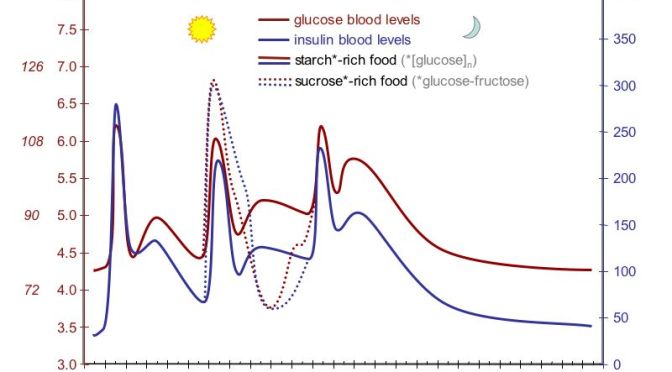
The graph above shows, among other things, how much insulin is in the
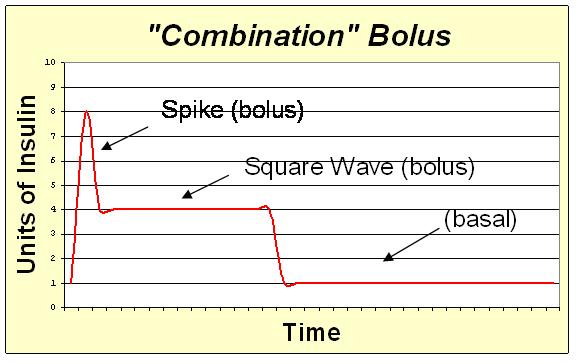
body over the course of a typical day. You can see how the “lulls” are still supported by that basal amount of insulin, and see the mealtime delivery of insulin in response to starch and sugar. You can pretty readily see that the insulin curve is more complicated than a single, steady-state dose with 3 peaks. That background insulin is far higher between meals than it is overnight. Thankfully, modern insulin pumps allow multiple basal rates depending upon the time of day! There’s a post-meal adjustment as sugars enter the bloodstream. Fast insulins might not have the sort of prolonged post-meal effect you see here (see our article on the Pizza Effect) but that follow-on dose can be synthesized wicombo_bolusth what they call a dual-wave or Combination bolus, wherein one programs some percentage of your mealtime insulin to be delivered as an all-at-once bolus, but then an increased background dose to deliver the rest over a prolonged period. For extremely fatty foods or for even healthy foods with a high glycemic index (carbs digested slowly), one might program a so-called square wave delivery of insulin, simply taking that steady background dose to an elevated level for a time – with no real bolus at all!