The Greatest Danger: Hypos

This is a hard post to write, because it’s about the scariest aspect of diabetes care: hypoglycemia. HyPER glycemia is high blood sugar concentration, and a long-term risk for all people with diabetes. This post is about hyPO glycemia, very low blood sugar, and it’s a deadly situation.
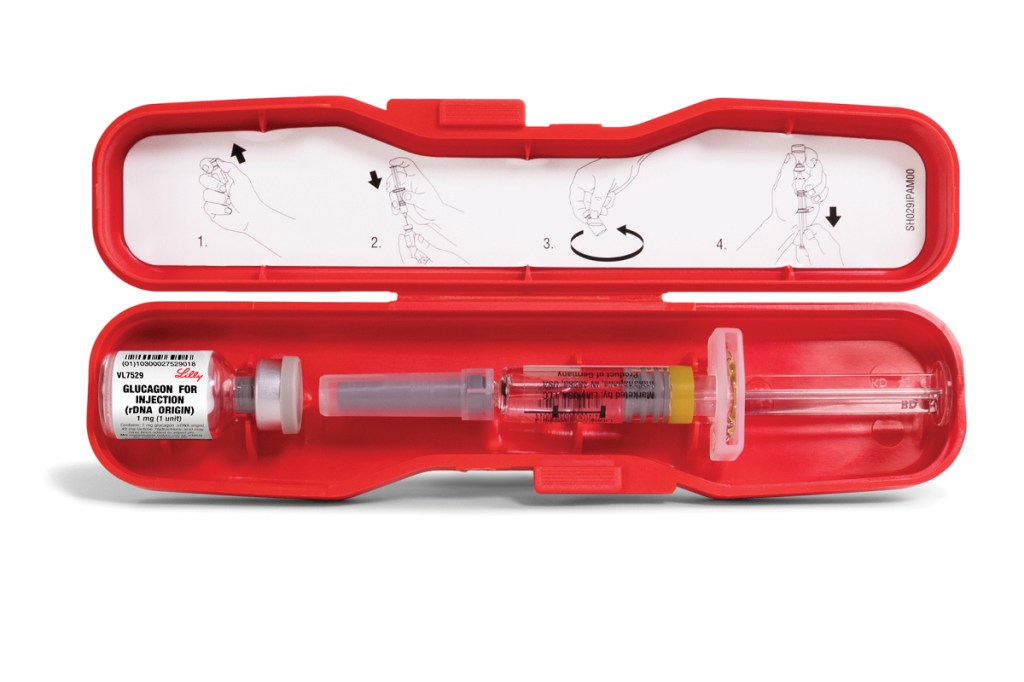
Eli Lily’s packaged glucagon

First of all, if your endocrinologist has somehow neglected to prescribe a glucagon syringe (pictured) get a prescription today (and maybe a new endo!).

Very low blood sugar deprives the nervous system of the chemicals it needs to function properly. The person suffering the “low” can lose consciousness and have seizures. If the low persists or worsens it can lead to death. Your perception of diabetes will change forever once your family experiences a hypo. Few things in life earn the term “terrifying.” A hypo with seizure is truly terrifying. It can be emotionally debilitating, because you now know that risk is always there, lying in wait. This is the part where I’m supposed to have something encouraging to say, but I got nuthin’. This sucks big time.

The main reason I write this post in a “beginning” diabetes blog, is because early after diagnosis, the person with diabetes will likely “feel” lows coming on, and may even be awakened. Sadly, crushingly, years of having blood sugar swings may make one less sensitive, and at risk of trending low overnight without recognizing it. For this reason, we consider Continuous Glucose Monitoring (CGM)to be a key component of the only humane health care course for those with diabetes. A CGM device with alarm, and preferably with “shutoff” control of insulin.

The glucagon pen above is the emergency treatment for someone who is low, likely recognized by entering siezure. I hate to break it to you, but a person with diabetes should never sleep alone. Good luck using that one at a singles bar! A sleepmate should always be in a position to recognize the twitching or thrashing of a seizure and trained to administer glucagon. The instructions are simple-enough, but you don’t want to be learning in the heat of an event! The glucagon triggers the liver to dump glucose into the blood stream, hopefully restoring consciousness.

To prevent low blood sugar events from reaching dangerous conditions, a CGM plus insulin pump work together to shut off insulin at selectable blood sugar concentrations. Modern pumps from Medtronic and Tandem can even use trending data to “Suspend Before Low” as the function is called. Living in great fear of hypos, we have selected the settings offering the highest-possible protection. Now, going without basal insulin for a while can result in a later “high,” but we’ve had good results in our household for the most part, with early morning blood sugars below 130 for the most part.

We’ll try to take up this dynamic interaction between automatic pumps and human metabolism at a later date. For the time being, get that glucagon and know where it is…and make sure you can hear, if not feel, your loved one who sleeps…and lives…with diabetes. Good luck! May these circumstances ever be strange to you and never experienced!


“Unitized” Foods

One of the most important elements in successful blood sugar managements is strict portion size. Obviously, knowledge of precise carbs-per-gram for a given food is meaningless if the number of grams is unknown or subject to error. One of the best things a family can do to support a person with diabetes is to embrace precisely measured, unitized food.

As you likely know, nutrition facts are required on a variety of foods, and we would guess there are penalties for “lying” – misreporting these figures. This gives food companies a legal motivation to properly calculate the nutritional values for their foods – including carbs. Once calculated, then it becomes a motivation for them to keep “serving” sizes consistent…to package the foods to precise quantities. Our results here have generally been very good. For food on the go, it’s best to be careful about sauces and such – like ketchup – which may be ladeled-on by a local employee who’s eager to please by “putting on a little extra.” As for the meal components themselves – buns, burgers, even nuggets with breading – these seem to be very reliable. It’s usually agreeable to the party to order a few extra chicken fingers, for instance, and let the person with diabetes choose the ones on which the breading seems the most “average!”

Supermarket meals – TV Dinners, if you will – are likewise quite reliable in our experience, which is a source of real comfort. Delicious and easy to prepare meals are available to suit most any taste, so long as you don’t demand the experience of “home cookin.” Pre-cut cookie dough has been close-enough, so long as you don’t eat too many, and cake mixes are reliable as well. Just make sure you weigh the baking pan first, and let the dish cool (losing weight as steam) before getting the cooked weight. Here’s the process:

1)Weigh pan

2)Determine number of servings in cooked quantity

3)Multiply servings times carbs per serving

4)Cook and allow to cool.

5)Weigh prepared dish. Subtract empty weight of pan, divide total carbs by grams of food.

6)Weigh each portion as you serve and multiply grams times ratio above.

This is obvious, but remembering to weigh the pan first saves a lot of worry later. We’ve found that things like paper cupcake wrappers – and the amount of cupcake that sticks to them – are negligible in these calculations, so enjoy!

A PLACE TO BE CAREFUL is pasta, and especially cheap ramen noodles. We’ve found that the actual dry weight is regularly 10% off of that posted (for a 20% variability!) simply weigh the ramen before preparing. Give the person with diabetes the one closest to the posted weight, or simply increment the carbs by the extra grams of material. We’ve had good results either way, but near-disaster without such care.

As in all things, empathy is critically important. Aunt Martha needs to understand that the person with diabetes may NEVER sample her cherry cobbler, and it is not a slight. Likewise, the rest of the family should be understanding that Aunt Martha doesn’t necessarily mean to take offence, she just has NO IDEA of how difficult blood sugar management can be, and let’s wish for her she never finds out.

The Protein Effect

If you or your loved one with diabetes is lucky enough to have an insulin pump, congratulations, again. Too few insurance providers recognize the superior results of insulin therapy using just the “fast” insulin. There are cases, though, where digestion takes a while, and the mealtime bolus is used up or is otherwise inadequate to aid digestion of non-carb foods. This applies in particular to a high protein meal, described elsewhere as “above 80 grams” of protein.

You’ll find your own rules and your own ratios, but it’s suggested that those who are on pumps with fast insulin plan on a second bolus 90 minutes to two hours after eating a big meal. This isn’t to account for the actual sugars you’ve eaten (carbs) but to account for sugars generated in the digestion of protein. The suggested ratio is one third to one half of your carb ratio for every gram of protein. My son has great results with a one third ratio, and he triggers the protein bolus one hour after starting the meal. This has been the last piece of the puzzle to get really good blood glucose numbers. His A1C was an enviable 5.5 his first test after learning of the effect! His subsequent A1C’s have been lower, still, but this is not a contest. Best of luck to you.

Some quick math – in trying to keep your carb intake low, your strategy may involve double burgers or some other way to get more protein without adding carbs. A fairly lean 4 ounce burger will have 18 grams of protein. A bun will have about 4 grams of protein, and a generous slice of cheese another 4. If you’re having  the equivalent of a double burger, a single and two buns, that’s around 60 grams of just protein, certainly approaching a big meal for anyone. Your meal bolus would be for the 40 or 50 grams of carbs in the buns and condiments. The Mass Effect – the sheer mass of protein to be digested and generating sugars – well, that would require additional insulin equal to 20 or 30 grams of your carb ratio,  taken about 90 minutes later.

This greater awareness of protein has led to the realization that lean poultry is an amazing source of protein. So great that the odds of having digestion issues are much more likely! Just be aware before you slam back that turkey breast sandwich!

As with any medical therapy, ask your doctor, but once you have the go-ahead and you’re experimenting with times and ratios, drop us a line! Pumps themselves, and the fastest new insulins, are both new-enough that this Mass Effect strategy is not well documented. We’d love to get a statistically-meaningful data set from readers and help formalize some best practices for folks with type 1. Again, good luck!

The Pizza Effect is Real – and a Real Drag

slice_p_pepperoni-slice

Just as our newly-diagnosed type 1 diabetes sufferer was getting the hang of managing carbs and insulin, we had an episode that shook our faith and courage. After carefully counting carbs and adjusting precise insulin ratios for weeks, we decided to try to feel normal and enjoy pizza.

We knew that pizza was high in carbs, but we’d just been given clearance to ramp-up carb intake and insulin dosages. We did…and the results surprised us! Minutes after injecting, then eating, everything looked good. Blood glucose levels staying in healthy range…success!

Only some time after eating did my son’s blood sugar start to rise…and rise…uncomfortably close to the numbers that drove him to the hospital in the first place!

Only after a bit of Googling did we find out about the Pizza Effect. The for-profit(?) education site Type1University has an excellent free video here.

It’s a shame that none of our physicians were familiar-enough with this effect to warn us. Our local Dietitian and Nutritionist insisted they’d never heard of it. Well, now YOU have.

Our experience is as the video and other online resources suggest. Carbs cloaked in grease simply take longer to be digested. Then, all at once, those carbs seem to hit a point in the digestive tract that they are digested in short order, maybe 9o-120 minutes after the meal itself and long after the insulin dose has peaked in effectiveness.

Now that my son is on an insulin pump he can take steps to address this effect. We’ll talk more about that in pumps, but the short version is that the pump can be programmed to release the insulin over time, rather than all at the beginning of the meal. I’ll update this page as we develop any helpful rules of thumb!

Testing, one-two. Six?

Whether you’re new to diabetes or not, you’re likely aware that the prices charged to insurance plans can vary widely. Only one of two pharmaceuticals regarded as identical may show up on your list of allowed drugs – or not – based upon negotiations that are entirely secret. In the best cases, this allows your insurance plan to put two drug firms into competition. Often in America, this means that the non-negotiated price – the retail price – is fabulously inflated. (See news stories on Epi-pens or Martin Shkreli.) We’re told that this higher starting point allows drug manufacturers to maintain enough margin to innovate on our behalf. A primary side effect is that those without insurance can find that many therapies are simply out of reach. Before the Affordable Care Act, stories of bankruptcies and deaths were prevalent. Knowing human nature, we suspect that many of these stories are absolutely true.

17_cnext_strip-carton_left-athero_100_picture_lowres_png

Even at their negotiated prices, insurance plans are often billed higher rates than you can find for diabetic supplies. This is one reason that plans seem to be so stingy. Your endocrinologist may earnestly submit a prescription for a reasonable 6 tests per day, and your plan budgets you for 4. It’s easy to think there is scholarship or experience behind the allowance, but don’t allow yourself to think this. It’s almost certainly just economics. Information is a key tool in type 1 diabetes, and you shouldn’t skimp.

…test strips…for less than 25 cents…

My son’s condition was discovered when he had an incidence of ketoacidosis. While he was still in intensive care he was prescribed Contour Next test strips. When he was released that’s what the Doctor prescribed, and now that he’s moved to an insulin pump, that’s what his integrated glucose tester uses. These strips can easily cost a dollar per test at your pharmacy. Once your deductible is met, I can’t say what your insurance plan pays, but if they’re saving $2 per day by limiting you to 4, that’s $720 per year. A shortsighted savings on their part, but a real savings. We have been augmenting our insurance-provided strips by buying test strips through Amazon.com for around 33 cents each. An extra 100 strips can give you peace of mind by allowing you to test more often each day for almost two months. That’s about $5 per week to allow you to check blood sugar when you’re curious, not just to inform a meal bolus.

We’ve never had any trouble with supplies ending up being post-dated or problems with strips that had been environmentally damaged in shipment. If your experience is otherwise, let us know! We’ll do some research on the vendor and help keep the good guys in business!